MARTÍN FIERRO STUDY GUIDE · THEMES · QUOTES · LITERARY ANALYSIS
Old Vizcacha vs. Martín Fierro: Two Ways of Learning from Life
The advice of the Old Vizcacha and the advice Martín Fierro gives his sons sound similar at first: both speak in memorable rural sayings and claim the authority of experience. But what kind of life does each recommend? One voice repeatedly asks how to survive; the other asks what kind of conduct might make living together possible.
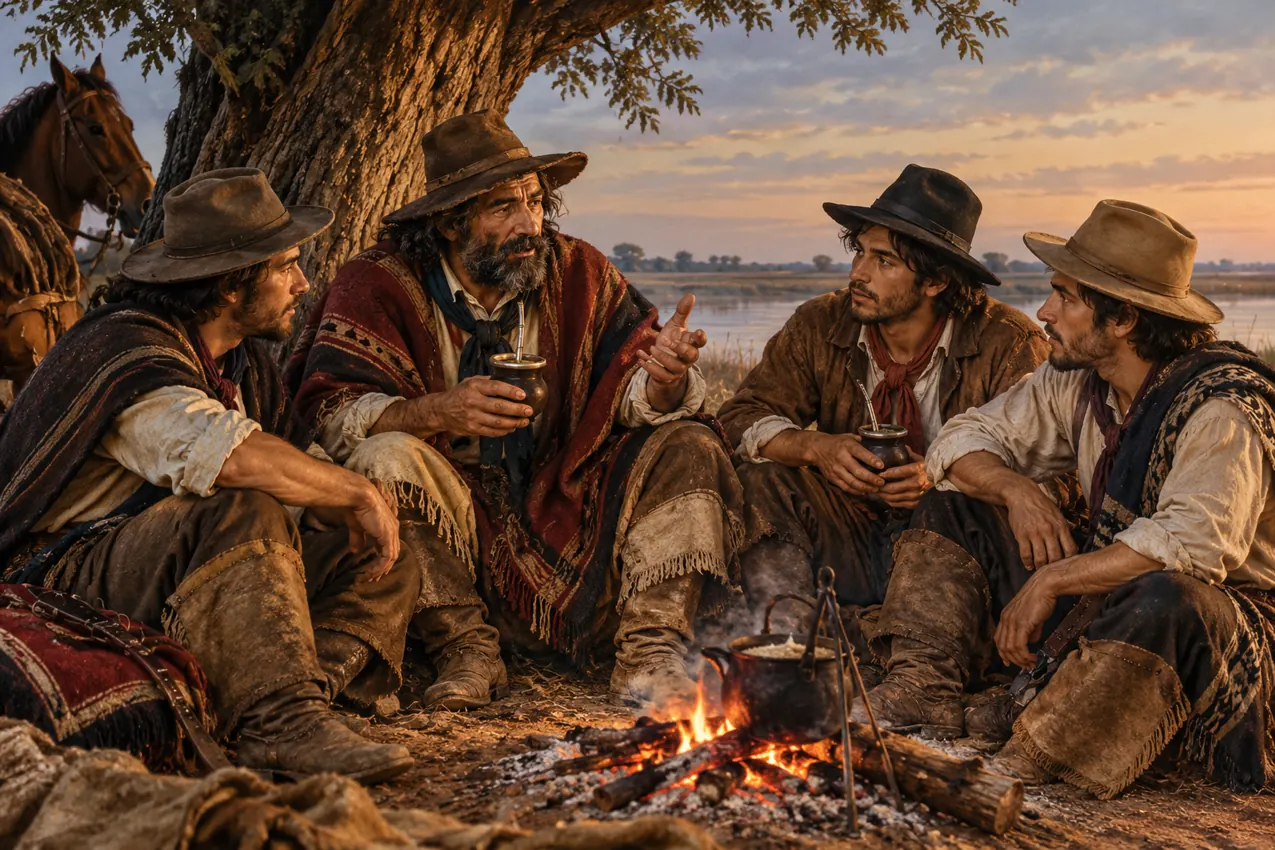
What is the difference between Martín Fierro and Old Vizcacha?
Old Vizcacha recommends caution, protecting oneself, seeking advantage and adapting to authority, sometimes at the expense of other people. Martín Fierro, speaking to his sons, stresses working, keeping friends, maintaining family solidarity and avoiding violence. That contrast is useful, but not absolute: both men are shaped by adversity, and Fierro has not always obeyed the ethics he later teaches.
These are two distinct speeches in La vuelta de Martín Fierro (1879). Vizcacha's words are reported by Fierro's younger son in Canto XV; Fierro addresses the younger generation in Canto XXXII. The two speakers must never be confused when quoting the poem.
1. Survival and the law
OLD VIZCACHA · CANTO XV · STANZA 758
"Hacéte amigo del juez;no le des de que quejarse;y cuando quiera enojarsevos te debés encoger,pues siempre es güeno tenerpalenque ande ir a rascarse."Read Canto XV in Spanish ↗MARTÍN FIERRO · CANTO XXXII · STANZA 1153
El trabajar es la ley,porque es preciso alquirir;no se espongan a sufriruna triste situación:sangra mucho el corazóndel que tiene que pedir.Read the complete father's advice ↗English commentary: Vizcacha tells the boy to cultivate the judge's favor: the advice rests on access to power. Fierro puts weight on working and sustaining oneself. These are different responses to an unequal society, not a simple split between a bad man and a flawless hero.
2. Age and experience
OLD VIZCACHA · CANTO XV · STANZA 757
"El primer cuidao del hombrees defender el pellejo.Lleváte de mi consejo,fijáte bien en lo que hablo:el diablo sabe por diablo,pero más sabe por viejo."Read Canto XV in Spanish ↗MARTÍN FIERRO · CANTO XXXII · STANZA 1145
Yo nunca tuve otra escuelaque una vida desgraciada:no estrañen si en la jugadaalguna vez me equivoco,pues debe saber muy pocoaquel que no aprendió nada.Read the complete father's advice ↗English commentary: Both speakers invoke hard experience. Vizcacha treats age as a survival advantage; Fierro admits that his difficult life has not prevented him from making mistakes. A memorable proverb becomes an argument about whether experience produces judgment or merely tactics.
3. Friendship and mutual obligation
OLD VIZCACHA · CANTO XV · STANZA 767
"Yo voy donde me convieney jamás me descarrío;lleváte el ejemplo mío,y llenarás la barriga:aprendé de las hormigas:no van a un noque vacío."Read Canto XV in Spanish ↗MARTÍN FIERRO · CANTO XXXII · STANZA 1150
Al que es amigo, jamáslo dejen en la estacada,pero no le pidan nadani lo aguarden todo de el:siempre el amigo más fieles una conducta honrada.Read the complete father's advice ↗English commentary: Vizcacha openly values moving where it serves his interests. Fierro urges loyalty to a friend without demanding repayment. Compare these values carefully: both men understand need, but they draw different conclusions about what one owes another person.
4. Prudence, cunning and conduct
OLD VIZCACHA · CANTO XV · STANZA 759
"Nunca le llevés la contra,porque él manda la gavilla:allí sentao en su silla,ningún güey le sale bravo;a uno le da con el clavoy a otro con la cantramilla."Read Canto XV in Spanish ↗MARTÍN FIERRO · CANTO XXXII · STANZA 1157
Nace el hombre con la astuciaque ha de servirle de guía;sin ella sucumbiría:pero, sigún mi esperencia,se vuelve en unos prudenciay en los otros picardía.Read the complete father's advice ↗English commentary: Avoiding conflict with the powerful is a recurring Vizcacha strategy. Fierro recognizes that cleverness may become prudence or deceit. His distinction complicates any easy claim that the two characters speak with entirely unrelated voices.
5. Family and relations with others
OLD VIZCACHA · CANTO XV · STANZA 770
"Si buscás vivir tranquilodedicate a solteriarmás si te querés casar,con esta alvertencia sea:que es muy difícil guardarprenda que otros codicean."Read Canto XV in Spanish ↗MARTÍN FIERRO · CANTO XXXII · STANZA 1160
Los hermanos sean unidosporque ésa es la ley primeratengan unión verdaderaen cualquier tiempo que sea,porque, si entre ellos pelean,los devoran los de ajuera.Read the complete father's advice ↗English commentary: Vizcacha argues for avoiding marriage and attachment; Fierro insists that brothers should stand together. Their advice points toward opposite responses to vulnerability: minimize obligations, or invest in durable bonds.
6. Violence and responsibility
OLD VIZCACHA · CANTO XV · STANZA 773
"Las armas son necesarias,pero naides sabe cuándo;ansina, si andás pasiando,y de noche sobre todo,debés llevarlo de modoque al salir, salga cortando."Read Canto XV in Spanish ↗MARTÍN FIERRO · CANTO XXXII · STANZA 1167
El hombre no mate al hombreni pelé por fantasía;tiene en la desgracia míaun espejo en que mirarse;saber el hombre guardarsees la gran sabiduría.Read the complete father's advice ↗English commentary: Vizcacha emphasizes keeping weapons ready. Fierro's warning against violence is striking precisely because he has killed before. His advice invites critical reflection, not absolution for his earlier actions.
Study questions and classroom discussion
- Which sayings are motivated by fear of poverty or authority, and which by a wish to live with others?
- Does age make either speaker trustworthy? Compare Vizcacha’s claim about old age with Fierro’s admission that he may be mistaken.
- How do Vizcacha’s warnings about attachments differ from Fierro’s advice to brothers?
- Why is Fierro’s warning against violence difficult to read as a straightforward claim of moral superiority?
- Which comparison changes most when read in the larger context of the poem?
These questions have more than one defensible answer. Use the actual verses and their narrative contexts rather than treating isolated proverbs as the full argument.
Frequently asked questions
Who is Old Vizcacha in Martín Fierro?
Old Vizcacha is the younger son’s guardian, whose pragmatic and often cynical advice is recalled in Canto XV of the 1879 sequel.
Where are the pieces of advice in Martín Fierro?
The sayings of Old Vizcacha appear in La vuelta de Martín Fierro, Canto XV. Fierro’s advice to his sons appears in Canto XXXII.
How are Old Vizcacha’s and Martín Fierro’s teachings different?
Vizcacha frequently favors self-protection, accommodation to authority and personal advantage, while Fierro places greater stress on labor, solidarity and honesty. Both appeal to practical experience, and neither voice is beyond criticism.
Sources, original verses and critical readings
All quoted Spanish lines on this page are rendered directly from the repository's La vuelta de Martín Fierro corpus. Commentary and comparisons are editorial interpretation, not a translation or an assertion that José Hernández endorsed every character’s words.
- Original poem: Canto XV, Old Vizcacha’s sayings
- Original poem: Canto XXXII, Fierro’s advice
- Argentina's Ministry of Education: Cuadernos para el aula, Lengua 6 (comparative reading activity)
- Liliana Bellone (2020): Los consejos del Martín Fierro y los del viejo Vizcacha
- Biblioteca Virtual Miguel de Cervantes: study of moral values in Martín Fierro
- Literary themes and analysis in English
For further reading: the complete father's advice with commentary and the English character guide.