HISTORY & CULTURE · ARGENTINA
What Is a Gaucho? Meaning, History, and Argentine Culture
Long before the gaucho became a familiar emblem of Argentina, men worked with cattle and horses across the grasslands of the Río de la Plata. Their lives were shaped not just by independence and open country, but also by demanding labor, shifting laws, and unequal access to land.
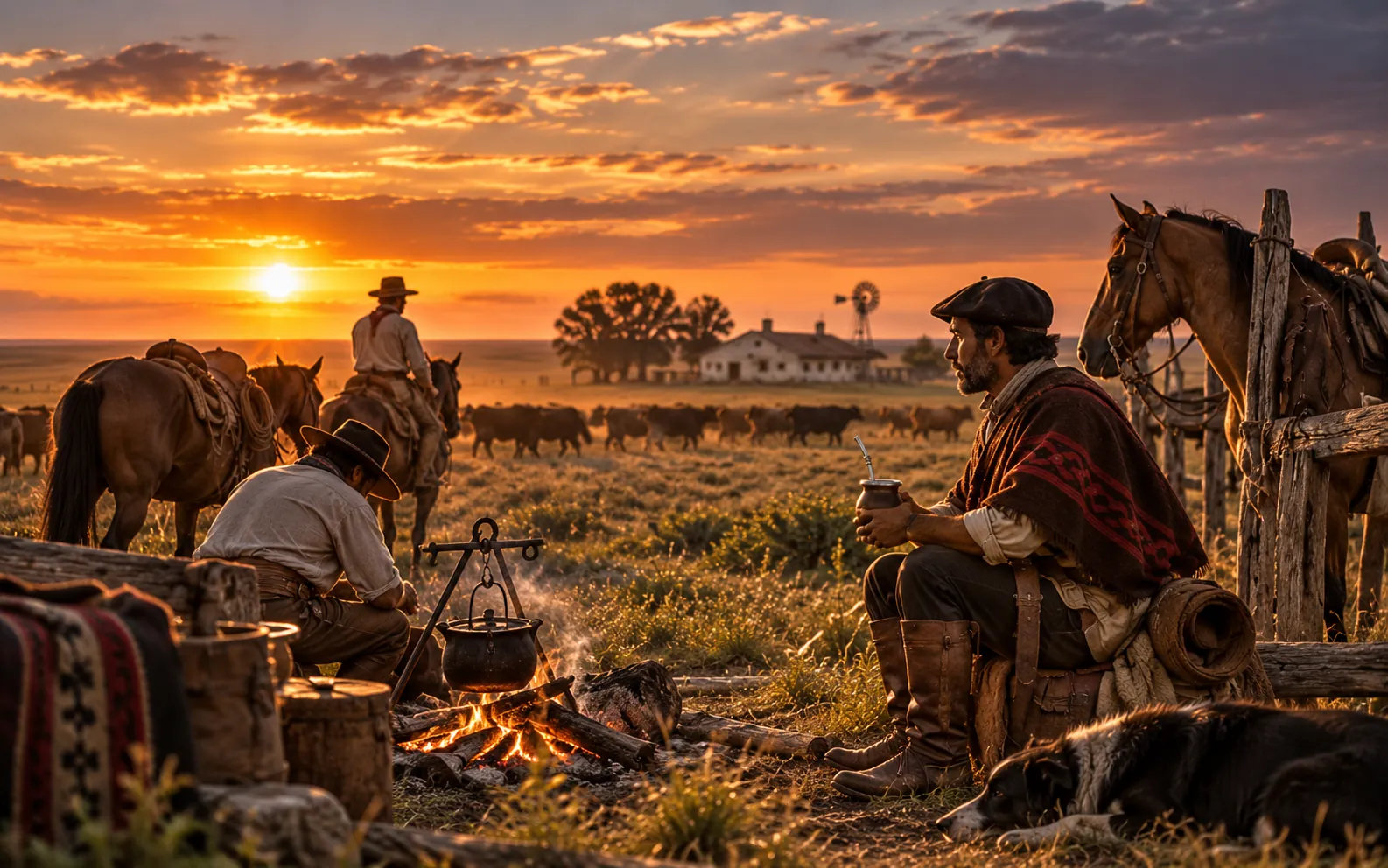
Gaucho meaning: what does the word mean?
In its most familiar modern sense, a gaucho is a horseman associated with cattle-raising life in the grasslands of Argentina, Uruguay, and neighboring parts of southern Brazil. That short gaucho definition is useful for a first encounter, but it does not tell the entire story. The term describes both historical people who performed demanding rural work and a cultural figure later celebrated in poetry, painting, music, festivals, and national narratives. Those two meanings overlap, but they are not interchangeable.
When English readers ask “what is a gaucho?”, they may picture an Argentine cowboy. Both figures are linked to horses, cattle, practical skill, and a mythology of freedom. Yet a gaucho is not simply a cowboy with different clothing. The Río de la Plata had its own colonial institutions, patterns of landholding, Indigenous relations, conflicts over labor, and nineteenth-century wars. Those circumstances shaped who was called a gaucho and what the label could imply.
The origin of the word itself has been debated. Etymological proposals have linked it to different regional languages and usages, but a single uncontested origin should not be presented as established fact. A dictionary meaning also changes with time: a term that officials once used to criticize mobile rural men could later become a symbol of admired independence. For a historically responsible answer to gaucho meaning, it is essential to distinguish a word's definition from the changing social judgments attached to it.
There is another practical distinction for English-language searches. “Gaucho pants” is a modern fashion term for a style of wide-legged trousers. It is not a definition of the historical gaucho, and the clothing name alone does not explain what nineteenth-century riders wore. This guide concerns the people, their history, and the literary world that made the word internationally recognizable.
How did gaucho society take shape?
The grasslands of the Río de la Plata supported large herds of cattle and horses over many generations. Colonial expansion, animal breeding, commercial demand for hides and meat, and the growth of ranching all contributed to a distinctive rural labor environment. The people who worked there were not a uniform community with one origin story. They came from varied backgrounds and lived under changing political and economic conditions.
It is misleading to imagine the pampas as an empty stage occupied only by solitary riders. Indigenous peoples had their own territories, political authorities, trade networks, and ways of life. European colonial settlements, African-descended populations, and people of mixed backgrounds also formed part of the region's complex history. Rural labor developed through contact, exchange, coercion, and conflict. Any description that erases those relationships produces an attractive legend at the expense of historical understanding.
As towns and ranches expanded, access to land and animals became increasingly regulated. Some horsemen worked for wages or seasonal payment; others moved between tasks and employers. Authorities often sought to classify men according to property, employment, and military obligations. The image of the completely independent gaucho therefore conceals a fundamental tension: riding across open land did not mean freedom from laws, employers, poverty, or recruitment.
Regional differences mattered as well. The practices of a worker near Buenos Aires did not perfectly match those of horsemen in Uruguay or Rio Grande do Sul. Even within Argentina, climate, cattle economies, and local customs varied. “The gaucho” is a useful historical category only when it leaves room for those differences.
What skills made a gaucho's work possible?
Riding was a working skill rather than a decorative performance. Moving cattle across extensive terrain required knowledge of animals, weather, water, pasture, and the condition of a horse. Riders had to read movement in a herd, respond to sudden changes, and cooperate with others. The romantic portrait of one man alone at sunset rarely shows the coordinated labor that sustained a rural economy.
Equipment reflected specific jobs. A lasso helped restrain livestock; weighted boleadoras were associated with hunting and animal handling; a knife could serve many ordinary tasks. Saddles and tack evolved through local practice and trade. These objects now appear in museums and celebrations, but their historical importance comes from their use, not simply their appearance.
Horses also carried social meaning. A skilled rider could earn respect, while the ownership and quality of horses reflected unequal resources. Being capable on horseback did not automatically confer wealth or security. Rural laborers remained vulnerable to bad seasons, changing demand, disputes with landowners, and state demands for service.
Who is missing from the familiar gaucho portrait?
Popular imagery tends to foreground a man, his horse, his poncho, and the open horizon. This is a narrow view of rural society. Women maintained households, raised children, traded goods, worked in and around rural establishments, and participated in networks of care and survival. Their presence is essential to understanding the families and communities behind the legend, even when older written sources paid them less attention.
Indigenous communities likewise cannot be treated as scenery around gaucho history. They negotiated, traded, fought, moved, and defended territory in a frontier that changed over time. Some people crossed social and cultural boundaries in ways that simple labels cannot capture. Afro-descendant rural workers and soldiers also formed part of the historical world. Their experiences deserve attention precisely because later national imagery often simplified the past into a single recognizable costume and face.
For students, this is a useful historical question: whose voice appears in the surviving documents, and whose perspective must be reconstructed with greater care? An official report, a traveler's memoir, a poem, and a modern festival photograph offer different kinds of evidence. They should not be treated as interchangeable witnesses.
Reading Martín Fierro as literature, not as a census
José Hernández's El gaucho Martín Fierro appeared in 1872, followed by La vuelta de Martín Fierro in 1879. The poem's central voice speaks in the first person, inviting readers into a life shaped by family, work, forced military service, flight, friendship, and violence. That intimacy is part of its literary power. It does not make every episode a direct record of what happened to every gaucho.
Hernández constructed a speaking character using the conventions of gauchesque poetry. The language draws on rural expression, performance, and song while remaining an artistic composition by a writer engaged with the politics of his time. Readers can therefore ask two different questions: what does the poem reveal about nineteenth-century conflicts, and how does the poet shape those conflicts into a persuasive narrative?
The distinction becomes especially important when considering the frontier. The poem portrays suffering and injustice, but it also contains language and assumptions that modern readers should examine critically, particularly in relation to Indigenous people and racialized characters. A serious reading need not choose between admiration and scrutiny. Its achievement can be studied alongside the limitations of its historical perspective.
Later interpretations made Martín Fierro central to discussions of Argentine identity. That reception is part of the poem's history, not proof that all Argentines or all gauchos shared a single experience. The literary gaucho is powerful because he concentrates tensions that extend beyond one man's story: authority and resistance, belonging and exclusion, law and fairness, memory and reinvention.
Questions for readers and students
Was a gaucho a job or an identity? Both descriptions can be relevant, depending on time and context. Rural occupations supplied the material basis for the figure, while language, public reputation, literature, and later cultural memory helped turn “gaucho” into a broader identity.
Did gauchos live only in Argentina? No. Closely related horse-based cultures developed in Uruguay and southern Brazil as well, though their names, histories, and national meanings are not identical.
Why is the word associated with freedom? Horseback mobility and the ideal of independence became prominent in literary and national representations. Historical workers, however, faced legal restrictions, economic pressures, and military obligations.
Why does Martín Fierro matter? It gives a memorable literary voice to conflicts involving rural labor, state authority, injustice, and dignity. It also shows how a fictional speaker can influence the way later generations imagine a historical community.
How should a student use this guide? Begin with the definition, separate documented history from later symbolism, read the poem as a crafted literary work, and consult the listed scholarship when evaluating a specific historical claim. That sequence is more reliable than treating a single famous image as the entire history of the pampas.
Who were the gauchos, really?
Imagine the Argentine grasslands before modern roads cut across them: livestock moving over immense distances, a rider carrying the tools needed for a day's work, and small rural settlements separated by open country. This landscape provides part of the setting for gaucho history. But it does not explain the people by itself.
The word gaucho has not always carried the affectionate meaning it often has today. In some eighteenth- and nineteenth-century documents, officials used it suspiciously, associating mobile rural men with disorder or a refusal to submit to established labor rules. Other descriptions praised their riding skills, hospitality, and independence. Those judgments tell us as much about the observers as about the people described. Historical accounts and scholarship provide contrasting views.
There was no single gaucho biography. The label encompassed people of different backgrounds and circumstances, including wage workers, experienced cattle hands, travelers, soldiers, and men trying to make a living outside stable employment. Rural society also included women, Indigenous communities, Afro-descendant people, landowners, and many others whose experiences cannot be compressed into the familiar solitary horseman.
Nor was the gaucho exclusively Argentine. Related riding and pastoral cultures developed across the Río de la Plata and southern Brazil, although local histories and modern meanings differ.
Working with cattle, living with horses
Horseback skill was indispensable in many cattle-raising districts. A rider might round up animals, separate livestock, drive herds, or help with the work of an estancia—a ranch or rural estate. The work could involve long days outdoors, changing weather, and occasional employment rather than a permanent household on a single property.
The gaucho's equipment reflected practical needs. A lazo (lasso) could be used to catch an animal; boleadoras, weighted cords, were another tool associated with horsemen; and a knife served several purposes in daily work. These items became cultural symbols, but their origins were practical rather than ornamental.
It is tempting to call the gaucho “the Argentine cowboy.” The comparison makes the broad relationship between riding and cattle clear. Yet the geography, political institutions, Indigenous histories, labor relations, and literature of the Río de la Plata were not identical to those of the American West. A useful analogy should invite curiosity, not erase the differences.
What did gauchos wear, eat, and do together?
Clothing for work, not a single costume
Popular portraits often show a gaucho in a broad hat, poncho, loose trousers, boots, and a knife at the waist. Historically, clothing changed with fashion, work, wealth, and region. The chiripá, a traditional wrapped garment, and bombachas, loose riding trousers, should not be assumed to have been universal or unchanged throughout the nineteenth century.
Mate, asado, and the rural gathering place
Mate, the infusion made from yerba mate leaves, and asado, meat cooked over fire, are important elements of regional food culture. They were not invented by a single group called “the gauchos,” however. Their histories involve wider Indigenous and South American societies as well as generations of exchange.
A pulpería could serve as a rural store and gathering place where people exchanged news, purchased necessities, and sometimes heard music. These encounters complicate the image of the gaucho as endlessly alone: the countryside also had its own networks of conversation, trade, conflict, and celebration.
Payadas: a voice carried by song
In the payada, singers known as payadores improvise or exchange sung verses, usually accompanied by guitar. This tradition helped shape gauchesque writing. As literary scholar Josefina Ludmer explains, the genre drew from popular song, oral performance, older poetic forms, and the deliberate craft of educated writers.
Land, law, and the frontier
Behind the romantic image of unrestricted movement lies a history of pressure on rural labor. Authorities sought to regulate mobility, identify workers, and recruit men for military service. Legal categories surrounding employment and alleged vagrancy could make everyday life precarious for people without secure property or paperwork.
The frontier was also a zone of commercial exchange, negotiation, warfare, displacement, and deeply unequal power relations between governments, settlers, and Indigenous peoples. It was never simply an empty wilderness waiting to be occupied. The language of nineteenth-century documents often reflects the prejudices and political aims of their authors.
Scholarship on the nineteenth-century countryside therefore invites a more complicated portrait: gauchos could be celebrated as expert riders and yet treated by authorities as people who needed to be controlled. This contradiction is central to understanding why a literary work about a gaucho could acquire political force.
How did the gaucho become Argentina's literary symbol?
In 1872, José Hernández published El gaucho Martín Fierro. Its narrator speaks and sings of family, forced frontier service, harsh treatment, and conflict with authority. The continuation, La vuelta de Martín Fierro, appeared in 1879 and broadened the story to include other voices, reunions, and moral counsel.
The poem belongs to gauchesque literature: writing that creates a stylized gaucho voice rather than transcribing every word of a single historical rider. The distinction matters. The fictional Martín Fierro is not a representative sample of everyone who worked on the pampas; he is an unforgettable literary character shaped by his author's choices.
In later decades, criollista literature, payadores, performance, festivals, and traditionalist organizations helped make the gaucho a symbol of Argentine identity. Historian Ezequiel Adamovsky has shown that popular criollismo could also express criticism of social and ethnic hierarchies. More recent scholarship emphasizes disputes over who has the authority to define the gaucho's past.
Understanding that history allows readers to admire the poem without confusing a national symbol with the whole diversity of rural Argentine life.
What Is Martín Fierro?
Explore the story, meaning, and historical background of José Hernández's two-part poem.
Read the English guide ↗Why does the gaucho still matter today?
The gaucho survives in literature, music, rural skills, celebrations, and the way Argentines discuss cultural memory. Yet modern traditions are not identical to nineteenth-century working life. A carefully restored outfit at a festival, an account by a foreign traveler, and an image in a poem are three different kinds of evidence.
For readers discovering Argentina, the gaucho is an extraordinary entry point into the country's history—but an entry point rather than a complete explanation. Following the story from horses and cattle to poetry and politics reveals the tensions that made the figure meaningful in the first place.
Frequently asked questions
What is a gaucho?
A gaucho is a historical figure associated with the horse-based rural world of the Argentine pampas and the wider Río de la Plata region. Gauchos worked with livestock, traveled between ranches and settlements, and occupied different social positions.
Were gauchos the same as American cowboys?
Both were skilled horsemen connected with cattle raising, but they emerged from distinct histories, societies, landscapes, and traditions. The comparison can be useful as a starting point, not an exact equivalence.
What did gauchos wear?
Clothing varied by region and period. Ponchos, boots or leather footwear, belts, knives, and several kinds of loose trousers or traditional garments appear in descriptions of rural life. There was no single timeless gaucho uniform.
How are gauchos connected to Martín Fierro?
José Hernández used a gaucho narrator to portray rural labor, forced frontier service, exclusion, violence, friendship, and the struggle for dignity in his two-part narrative poem, published in 1872 and 1879.
Sources and further reading
The article synthesizes historical testimony and research; it is not a literal translation of a historical source. The scholarly works below support the distinction between everyday rural history, nineteenth-century descriptions, and later cultural symbolism.
- El gaucho en la historia y en la tradición argentina, Biblioteca Virtual Miguel de Cervantes — compilation of historical accounts, including nineteenth-century travelers.
- Josefina Ludmer, “The gaucho genre,” The Cambridge History of Latin American Literature — the literary genre and its oral and written traditions.
- Ezequiel Adamovsky (2018), “Criollismo, experiencia popular y política: el gaucho como emblema subversivo” — social meanings of popular criollismo.
- Matías Emiliano Casas (2024), “¡Con los gauchos no!” — traditionalist and academic debates over gaucho history.
- Richard W. Slatta (1980), “Gaúcho and gaucho” — comparative social and economic histories across the region.
Editorial note: Illustrations are identified separately from documentary evidence. The original Spanish poem is available in our reader (Spanish); this article is original English explanatory prose.