FATHERHOOD · FAMILY · WISDOM · ORIGINAL SPANISH VERSES
A Father Who Gives Advice Is More Than a Father: Martín Fierro Explained
The first words of Fierro’s advice join two roles: a father and a friend. Yet the next lines turn to danger, uncertainty and the lessons of a hard life. The result is tender without being sentimental.
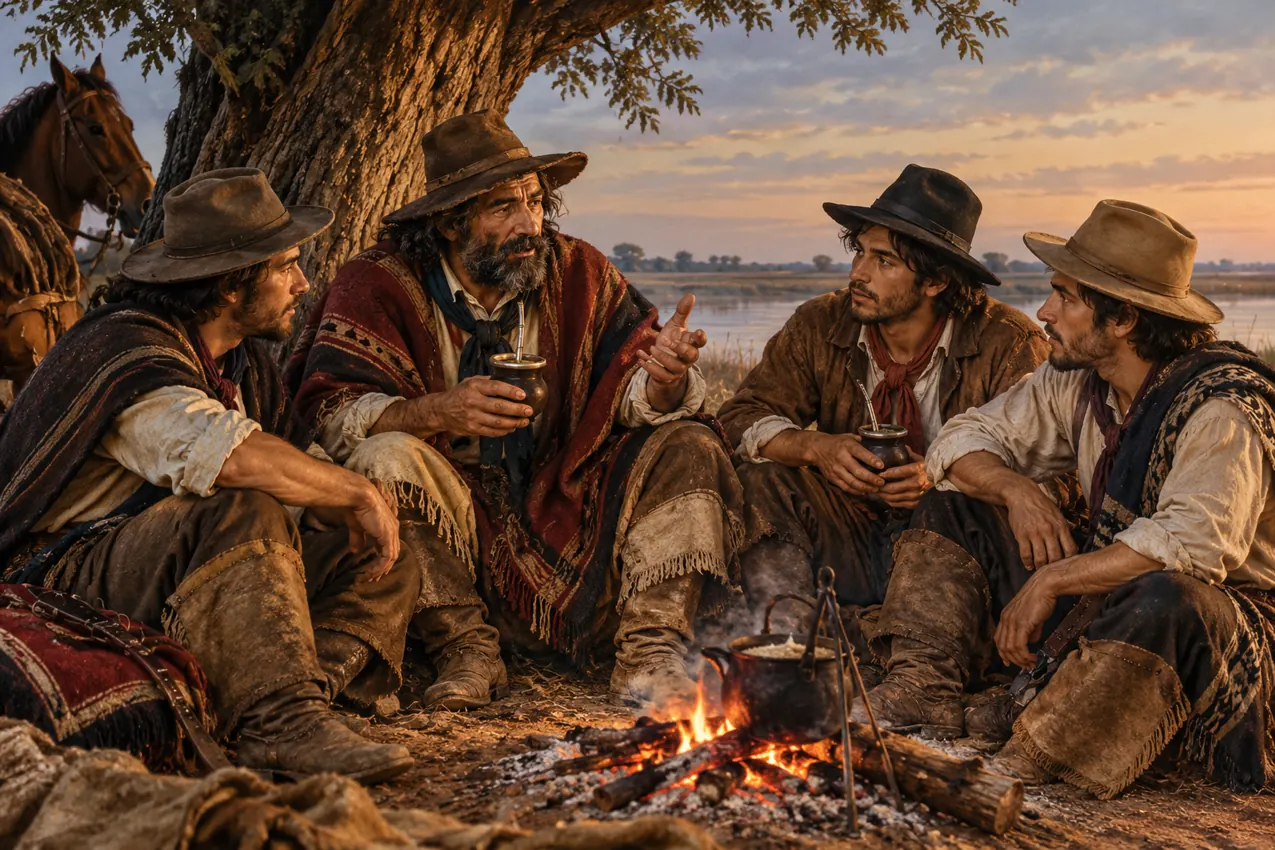
The original verses, Canto XXXII (1879)
These selected stanzas are drawn directly from the site's original Spanish corpus; editorial explanation follows separately.
Estrofa 1144
-Un padre que da consejosmás que padre es un amigo;ansi como tal les digoque vivan con precaución:naides sabe en que rincónse oculta el que es su enemigo.See the stanza in the complete canto
Estrofa 1145
Yo nunca tuve otra escuelaque una vida desgraciada:no estrañen si en la jugadaalguna vez me equivoco,pues debe saber muy pocoaquel que no aprendió nada.See the stanza in the complete canto
Estrofa 1146
Hay hombres que de su cenciatienen la cabeza llena;hay sabios de todas menas,mas digo, sin ser muy ducho:es mejor que aprender muchoel aprender cosas gúenas.See the stanza in the complete canto
Reading the poem with care
A father and a friend
The first stanza presents counsel as an offer of companionship rather than command. The speaker claims the authority of experience, but he also acknowledges the fear that danger can be hidden nearby. A reader can value the invitation to trust while noticing the defensiveness that years of conflict have produced.
Admitting that a life can teach imperfectly
The next stanza admits that Fierro has learned through misfortune and may still be mistaken. His capacity to advise is therefore not proof that he has behaved without fault. That admission gives the relationship more human depth.
Learning what is worth knowing
The distinction between learning much and learning good things asks what education is for. It is not an argument against knowledge: the speaker is asking what kinds of knowledge guide action well. The colloquial spellings belong to the original literary voice.
A question for present-day families
Can parents offer guidance while remaining open about their own errors? This is a contemporary reflection prompted by the poem, not a timeless rule that Hernández explicitly established for all families.
Original text and reading companions
José Hernández, La vuelta de Martín Fierro (1879), Canto XXXII. The quotations are read from the same repository corpus as the Spanish reader. This article is original English interpretation, not a translation or a claim about Hernández's personal beliefs.
Read the complete original canto · All 31 stanzas with commentary · Literary analysis