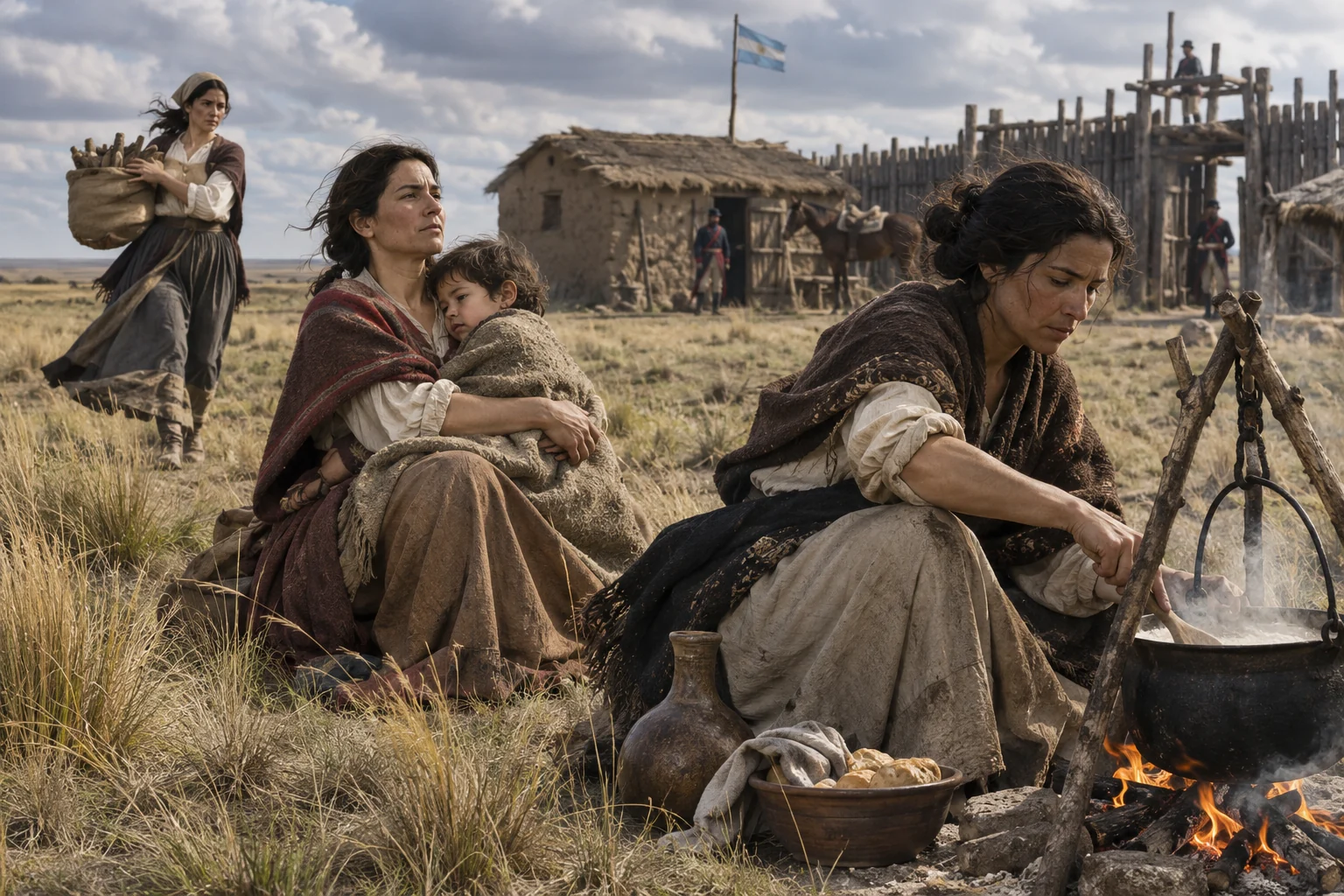
Who were the fortineras?
The Museo Roca describes fortineras as women who lived in or accompanied the military communities of the frontier. Some were soldiers’ wives or relatives; their lives cannot be reduced to a single role or status. Historical descriptions refer to hunger, cold, movement between posts and essential daily tasks. The word names a historical presence, not a uniform biography.
A remembered woman: Domiciana Correa
Institutional historical research identifies Domiciana Correa in the memory of Carhué as a fortinera, midwife and healer. Her story matters precisely because it offers a particular name and place. It would be misleading to turn one remembered individual into an example that explains every woman on the frontier, or to supply undocumented episodes from her life.
Care, food and ordinary objects
Women could be involved in preparing food, caring for children and sick people, finding supplies and coping with military movements. Material remains offer a different perspective from dramatic narratives. Archaeological study of ceramics from forts in southern Buenos Aires investigates patterns of consumption, provisioning and social distinction; an excavated object cannot automatically be assigned to a particular person or task.
What Martín Fierro does and does not show
Fierro’s wife, the captive woman in the sequel and other female figures occupy important places in the poem. Yet none is a direct documentary portrait of a fortinera. Their experiences are filtered through the male narrator and the literary conventions of their period. Reading the poem beside research on real women makes the absences in the narrative easier to notice.
Recovering more voices
A fuller history must draw on military registers, censuses, personal testimony and securely identified photographs. Much of that evidence is fragmented or shaped by institutions that rarely let women speak for themselves. A responsible article acknowledges those gaps instead of filling them with invented dialogue or biographies.
Sources and editorial method
This original English article follows documented themes in the Spanish research edition, while maintaining a distinction between historical evidence, modern interpretation and the fictional testimony of Martín Fierro. Linked sources remain under their custodians’ control.
- Museo Roca — who were the fortineras?
- Archaeological study of ceramics at frontier forts
- Museo Roca — dwellings at frontier outposts
Read the poem in its original Spanish
El gaucho Martín Fierro — Canto 3 ↗El gaucho Martín Fierro — Canto 6 ↗
← More English cultural essays · Introduction to Martín Fierro