SOCIAL HISTORY · THE RÍO DE LA PLATA
What Was a Pulpería? The Rural Shop at the Heart of Gaucho Life
A pulpería was more than a place to buy provisions. Across the rural Río de la Plata, it could bring neighbors, itinerant workers and travelers together to exchange news, share stories and hear music.
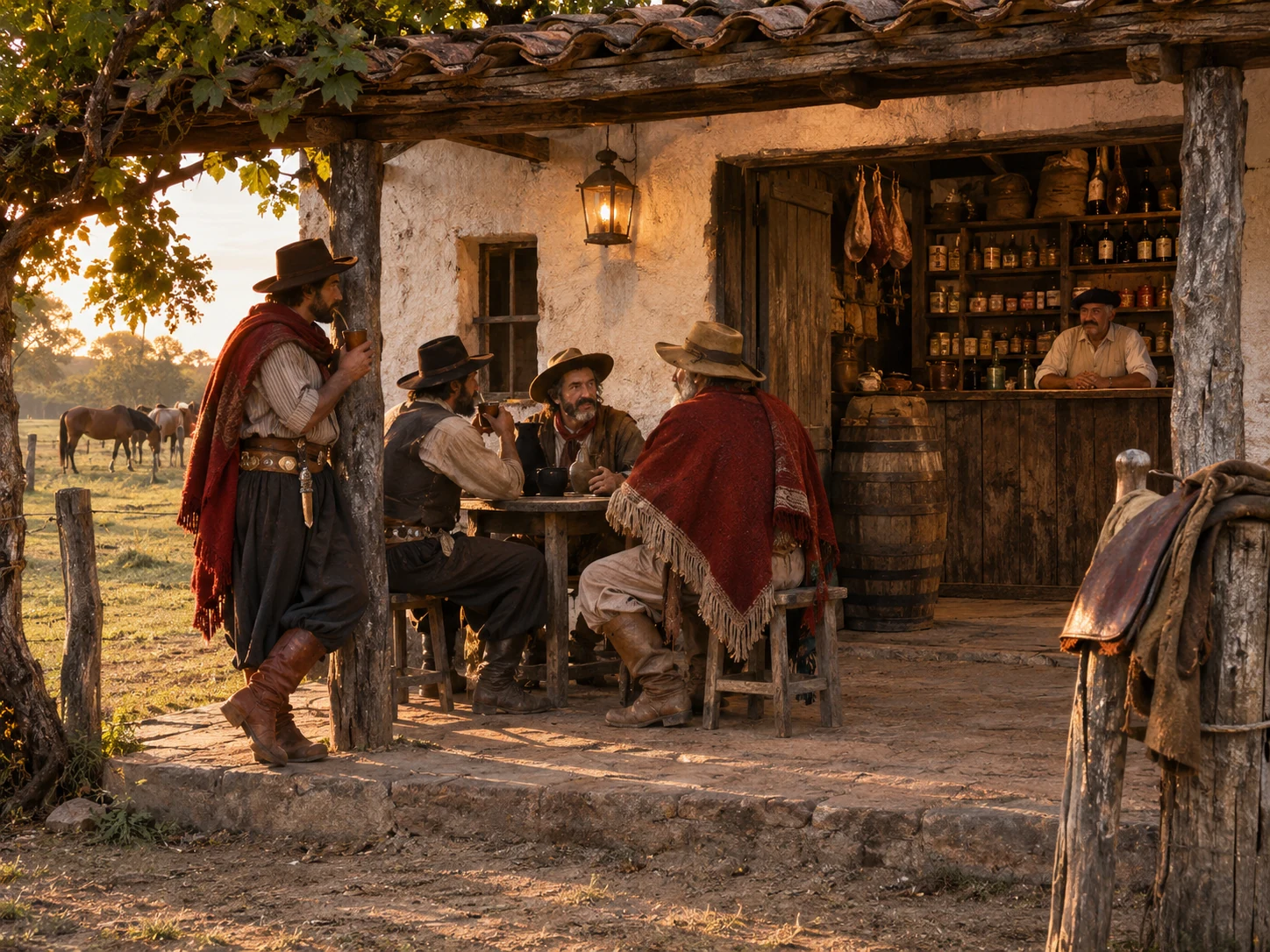
A shop in a landscape of long distances
In the nineteenth-century countryside of Buenos Aires and neighboring areas, journeys between settlements could be long and difficult. A pulpería offered practical supplies: food, drink and other everyday goods. Its social importance came partly from geography. When people lived and worked far apart, a place to purchase necessities could also become a place to meet.
Not every pulpería looked or operated alike. Its stock, clientele and significance changed from one region and decade to another. Calling it an Argentine “saloon” may help an English-speaking visitor imagine a meeting place, but the comparison misses its role as a general store and part of local trade.
News, music and rural sociability
Information did not travel only through newspapers and official announcements. Conversation at shops, roads and gatherings linked rural communities. A pulpería might be a setting for guitar playing, drinking, argument or improvised song—but none of those activities was universal.
The payada, a tradition of sung poetic exchange, belongs to a wider musical and literary world. A payador could engage an audience through rhythmic verse. Gauchesque authors drew on such conventions, shaping them into works intended for readers as well as listeners.
The pulpería in Martín Fierro
José Hernández did not describe rural establishments as a neutral historian writing a survey. In El gaucho Martín Fierro, the narrator’s encounters with social spaces reveal his relationships with work, authority, song and violence. Those scenes are vivid literary evidence of the world Hernández imagined, not a census of what happened in every shop.
One particularly disturbing episode involves the killing of an Afro-descendant man after a conflict in a pulpería. The poem’s racial insults and the narrator’s efforts at self-justification should be read critically. Turning the scene into folklore without its violence would misrepresent the work.
La Blanqueada: a place with a documented heritage
The official Argentine heritage record for the Puente Viejo, Museo Gauchesco Ricardo Güiraldes and La Blanqueada site in San Antonio de Areco provides a useful example of how historic rural places become part of public memory. It connects the site with local tradition and a larger twentieth-century museum project.
The association between La Blanqueada and the bridge built in 1857 is described in that record through oral tradition. Oral association does not prove the precise construction date of the surviving building. Historical structures, museum displays and artistic reconstructions must be distinguished.
What the pulpería can teach us
Studying the pulpería connects everyday rural commerce with the history of transport, labor and informal communication. It also reveals how later generations selected certain objects and places to represent gaucho identity.
For readers approaching Martín Fierro in English, this is a useful distinction: the poem opens a window onto the countryside, but careful historical research helps establish what we can—and cannot—see through it.
Sources and further reading
This article is original English editorial writing based on documentary and institutional materials. Historical claims and interpretations should be distinguished from poetic scenes and modern reconstructions.