THE GAUCHO WORLD · ENGLISH CULTURAL RESEARCH
What Is a Payada? Gaucho Poetry, Guitar and Improvised Song
In a payada, words become a public performance. Singers use verse and melody to tell stories, answer one another and sometimes compete. This living tradition offers a way into the poetic world that José Hernández created in Martín Fierro.
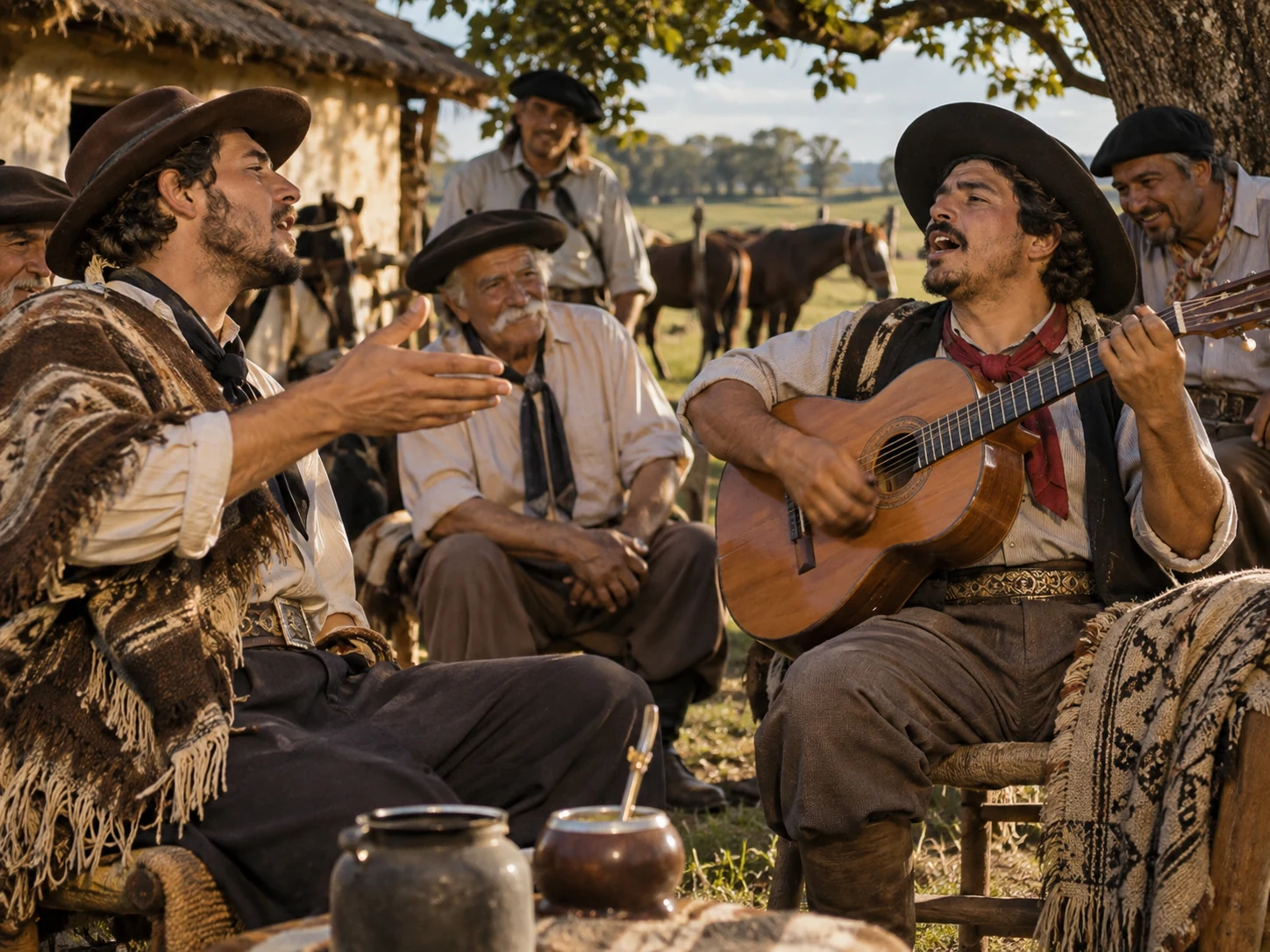
The payador and the improvised verse
A payador is a singer-poet, often accompanied by guitar. In many forms of payada, the performer improvises verse in response to a subject, an audience or another singer. The poetic exchange is often called a contrapunto. Different performers and places have distinct practices; not every sung piece involves spontaneous competition.
The skill is literary as well as musical: the singer must shape rhyme, rhythm and meaning while responding to what has just been said. A performance is not identical to a prewritten song, although both may share conventions and repertories.
Oral tradition and written literature
The gauchesque genre drew on oral performance and on educated writers' deliberate craft. This distinction is central in scholarship on the genre: a poet writing a gaucho narrator is not simply recording an anonymous performance.
In the opening canto of El gaucho Martín Fierro, the narrator presents his song as the means to recount his experiences. Hernández gives readers a powerful illusion of hearing a voice directly, even though they are reading a printed literary work.
The celebrated encounter with the Moreno
In the sequel, Fierro faces an Afro-descendant singer known as the Moreno in a contest of questions and answers. The exchange gives language a central dramatic role and recalls an earlier episode of racial violence in the first part.
The Moreno who sings in the payada is not the man Fierro previously killed. The connection between the two scenes makes it essential to examine the narrator's language, memory and claims to honor, rather than presenting the encounter as a harmless musical contest.
How to listen and read
A useful introduction is to compare the first canto, where Fierro declares himself a singer, with the later payada. Notice how the singing voice changes from personal complaint to public questioning.
The tradition continues to be performed and discussed, but a modern festival recording should not be described as an unaltered recreation of the nineteenth century. Every performance belongs to its own time and context.
Historical context: what is a gaucho?
The literary dimension of gaucho meaning becomes clearer when rural song is distinguished from the written gauchesque genre. For readers asking what is a gaucho, our guide to gaucho history and Martín Fierro provides the social background.
Sources and editorial method
These notes expand the research and vocabulary of our Spanish cultural guide for an English-speaking audience. Historical claims, literary representations and modern editorial images are distinguished. External documents remain with their original custodians.
- Josefina Ludmer, The Gaucho Genre (Cambridge scholarly overview)
- Martín Fierro: Part One, Canto I (original Spanish)
- Martín Fierro: Part Two, Canto XXIX (original Spanish)
- Martín Fierro characters: the Moreno (English)
← Return to the English cultural magazine · An introduction to Martín Fierro