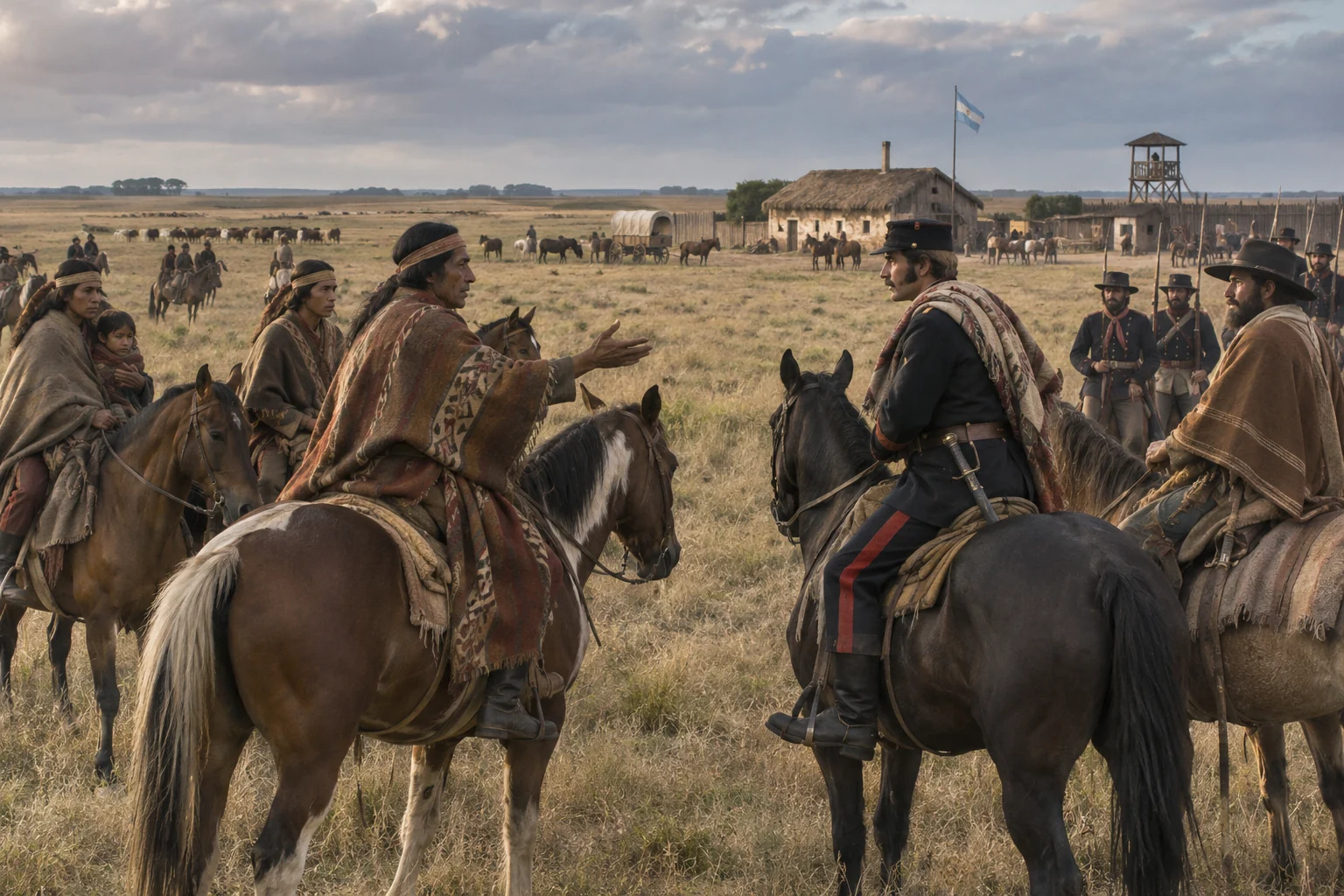
A frontier that moved
Maps of the southern frontier between 1779 and 1879 show major territorial changes. Educational resources from Buenos Aires Province explain the different moments of conflict, negotiated relations and state expansion. Such maps are useful evidence, but they also reflect the aims and categories of those who drew them. Indigenous territory must not be described as uninhabited simply because the nineteenth-century state sought to occupy it.
Settlements, agreements and land
Historian Melina Yuln has researched Indigenous settlements in the south and west of Buenos Aires and the treatment of land by state authorities. Period records use the term indios amigos for certain communities in political or military relations with the government. That expression is a state-era category, not a general name for Indigenous peoples or an explanation of their identities.
Indigenous political choices and military service
Research by Luciano Literas on the groups associated with Rondeau and Melinao shows why frontier history cannot be told solely as clashes between opposing armies. Indigenous leaders and communities negotiated, served, refused or sought advantages in circumstances of unequal power. Documented participation in military structures does not erase the larger history of coercion or territorial dispossession.
Reading Martín Fierro against the archive
The scenes of recruitment in the first part and Fierro’s time among Indigenous communities in the second are told from his viewpoint. The text includes sweeping judgments, hostile descriptions and violence. They are part of the work’s nineteenth-century literary representation, not the voices of the Indigenous communities being described. Critical reading can respect the poem as literature without repeating its prejudices as fact.
What the history must include
A more complete inquiry needs historical maps, treaty records, Indigenous testimony and studies attentive to their archival mediation. The advance of state forces culminating in 1879 brought death, captivity and dispossession to Indigenous peoples, as contemporary educational scholarship explicitly acknowledges. That history cannot be replaced by a romantic image of the frontier.
Beyond a simple two-sided story
The southern frontier involved Indigenous groups, military officers, settlers, workers, women and traders with changing relationships. Distinguishing an archive’s terminology from a community’s own name is one small but important step toward telling that history more accurately.
Sources and editorial method
This original English article follows documented themes in the Spanish research edition, while maintaining a distinction between historical evidence, modern interpretation and the fictional testimony of Martín Fierro. Linked sources remain under their custodians’ control.
- Melina Yuln — Indigenous settlements and frontier land
- Luciano Literas — Indigenous militarization, 1850–1870
- Mónica Quijada — rethinking the southern frontier
- Buenos Aires Province — changing frontier maps, 1779–1879
Read the poem in its original Spanish
El gaucho Martín Fierro — Canto 3 ↗El gaucho Martín Fierro — Canto 4 ↗
← More English cultural essays · Introduction to Martín Fierro