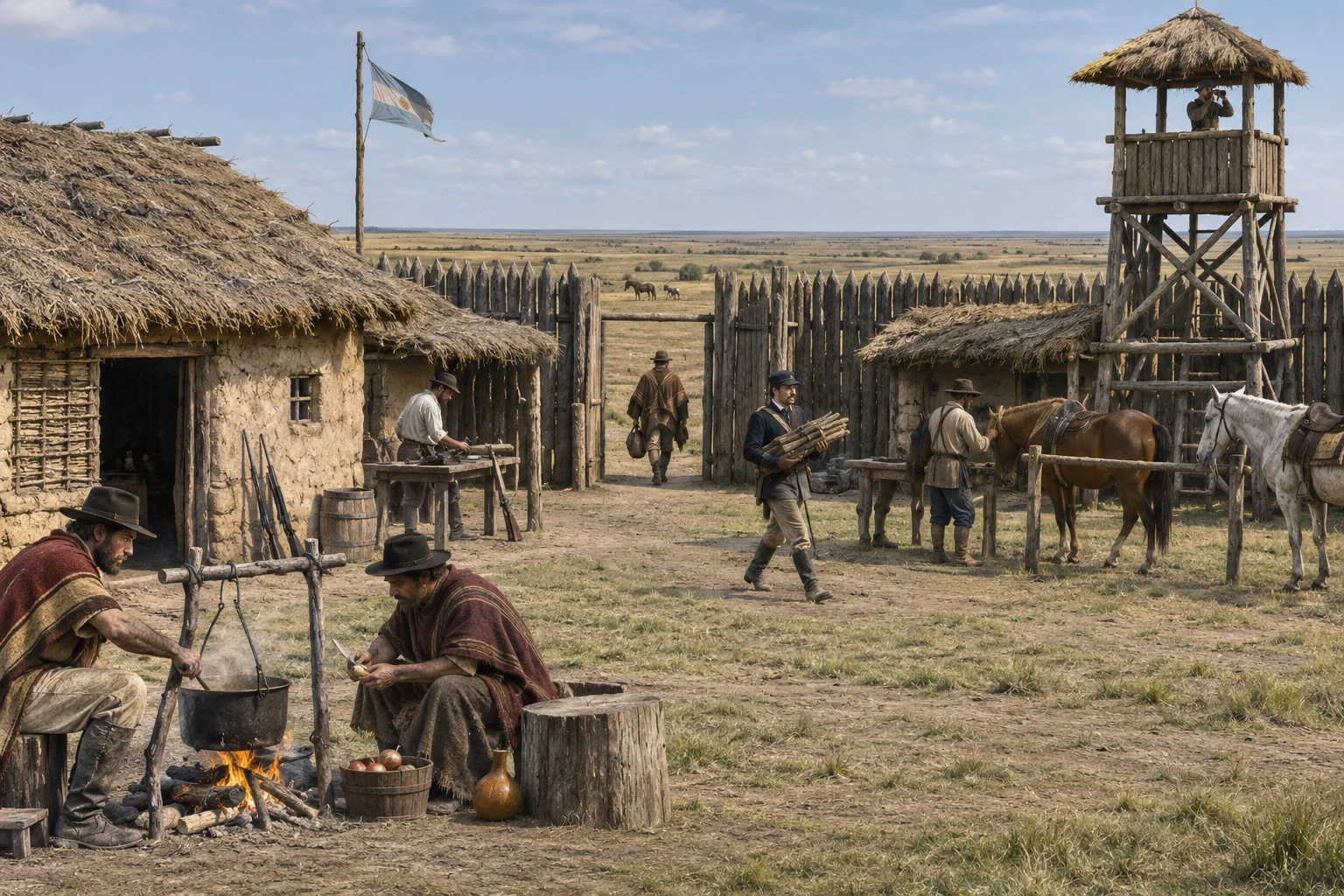
Not every fort looked alike
Historical research from the Museo Roca distinguishes larger forts from smaller fortines. Larger establishments could contain command spaces, barracks, storehouses, medical facilities and defensive structures. Smaller posts might chiefly provide observation and communications between positions. Their layouts depended on geography, resources and date. There was no universal model for the Argentine frontier.
Shelter made from available materials
Museum research based on photographs taken in 1883 by Carlos Encina and Edgardo Moreno describes dwellings made with quincha: branches and reeds combined with mud. These structures help historians investigate construction techniques, but the photographs were taken eleven years after the 1872 publication of El gaucho Martín Fierro. They cannot serve as direct visual evidence of the episodes in the poem.
The labor behind military service
Life at an outpost also required cooking, obtaining water, feeding animals, maintaining shelter, watching roads and transporting supplies. Soldiers and civilians experienced shortages and discomfort differently. Educational materials from Buenos Aires Province also describe games and gatherings in the intervals between military duties. Avoid imagining every day as a battle or every settlement as equally supplied.
The frontier in Martín Fierro
In Cantos III and IV of the first part, Fierro narrates recruitment and the ordeal of frontier service. His voice gives an extraordinarily forceful account of deprivation and abuse. Yet the poem is a literary narrative, told by a fictional speaker. Comparing its scenes with dated plans, supply records and photographs clarifies the difference between a historical setting and a character’s testimony.
What historical investigation still needs
A careful reconstruction would compare the records of particular forts, dated maps, muster rolls, inventories and named individuals. Evidence from 1883 may illuminate a building type without proving its exact appearance in 1872. The most useful question is not simply what the frontier looked like, but whose lives each surviving document allows us to see.
Sources and editorial method
This original English article follows documented themes in the Spanish research edition, while maintaining a distinction between historical evidence, modern interpretation and the fictional testimony of Martín Fierro. Linked sources remain under their custodians’ control.
- Museo Roca — forts and fortines
- Museo Roca — frontier dwellings
- Buenos Aires Province educational materials — frontier expansion
Read the poem in its original Spanish
El gaucho Martín Fierro — Canto 3 ↗El gaucho Martín Fierro — Canto 4 ↗
← More English cultural essays · Introduction to Martín Fierro