ENGLISH RESEARCH · GAUCHO HISTORY & LITERATURE
Gaucho Pants Origin: The History of Bombachas and Traditional Dress
The loose trousers associated with Argentine gauchos are often called bombachas de campo. Their history is more complicated than the idea of a single timeless gaucho uniform—and claims about their origin need dated evidence.
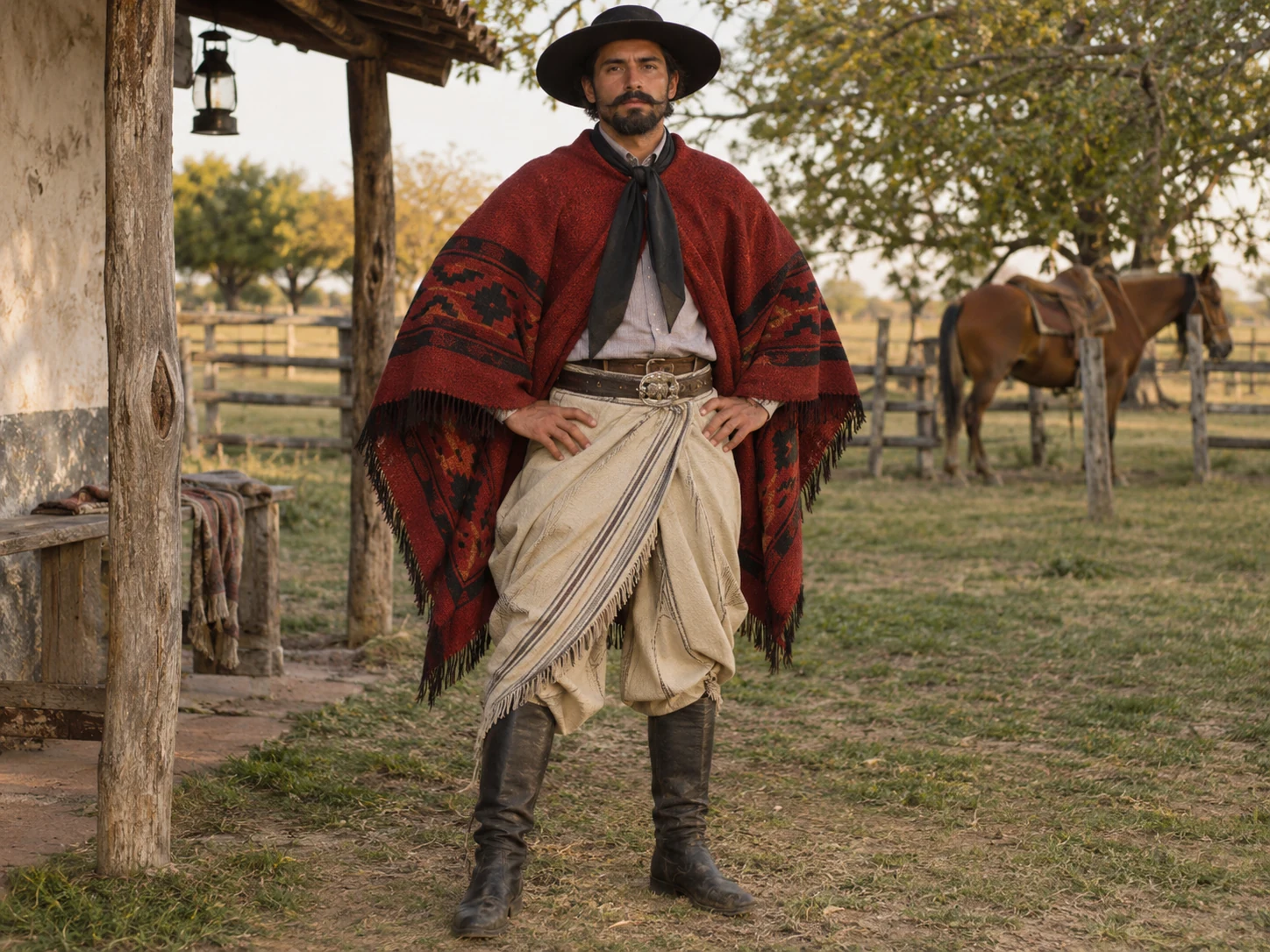
What are gaucho pants?
In Argentina, bombachas are loose riding trousers commonly associated with rural dress. Their cut allows movement on horseback, while the lower leg is gathered or narrowed. English searches for gaucho pants may also return modern wide-legged fashion garments; those are not necessarily the same historical item.
The difference between bombachas and chiripá
The chiripá is an older wrapped garment held around the waist and worn with other clothing. Bombachas are trousers. Historical portrayals of gauchos encompass changing styles and different social situations. One cannot look at a modern traditionalist outfit and assume it depicts exactly how a rider dressed in the early nineteenth century.
The often-repeated Ottoman connection
A historical interpretation published by Rosendo Fraga in La Nación associates the arrival of bombacha-style trousers in the Río de la Plata with clothing used in the Ottoman world. This is a specific historical argument, not proof that every feature of gaucho clothing has one Middle Eastern origin. The story should be presented with attribution rather than repeated as an established universal fact.
What evidence would settle the question?
Establishing the route and date of a garment requires dated import records, military supply documents, photographs, museum objects and contemporary descriptions. Terminology itself can shift. A strong historical comparison also distinguishes the cut of a garment, the route by which it traveled, and the social groups that later adopted it.
Why clothing matters in reading Martín Fierro
Hernández's poems were published in 1872 and 1879, during a period of change in rural labor and society. They evoke tools, riding and social expectations, but a fictional narrator does not supply an inventory of everyone's clothing. The best approach is to read the poem alongside documented artifacts and avoid placing later costume fashions uncritically into earlier scenes.
A wider guide to gaucho dress
Ponchos, belts, boots, knives and saddle gear have separate histories. For a broader explanation of the objects and terms, continue with our guide to gaucho clothing and the illustrated cultural glossary. Not every garment or practice associated with a gaucho originated in one country or at one date.
Sources and further reading
This article distinguishes documented historical claims, scholarly interpretation and literary representation. Historical material is linked to the source institution or publication; original Spanish verses have not been modified or republished in translation here.